October 27, 2014

Globalization Creates Migration from Third World

Selina is married with three children and is a loving Christian woman who applauds globalization for raising the standard of living in third-world nations but is dismayed by its effects on the movement of people away from those nations towards her back yard.

"Yes," laughs Selina, "I suppose I am one of those ridiculous NIMBY people but I can't understand why these people want to come here when the global powers have done so much to improve living conditions in their own lands."

"Theoretically, globalization helps third-world nations by providing work for populations that are unemployed and living in poverty," says Selina, "but I can also see how it hinders third-world nations by exporting western values that, in turn, create jealousy or antagonize the purists in those nations."

"How often do we hear about western trained doctors and other professionals who, once qualified at our expense, don't want to stay in their country of origin to help their own people?" sighs Selina. "And how often do we hear about young people from third-world countries who, given a taste of western education and culture, will do whatever it takes to come here and enjoy the real thing? And how often do we hear about the religious fanatics, the purists, in third-world countries cracking down on young people who adopt western values?"

"By committing acts of terror against the West, as well as against their own people who adopt western values," says Selina, "the fanatics are deliberately or otherwise pushing the global powers into becoming more controlling."

"As I see it, the global powers moved into the third-world to help the people - to educate them, to provide them with work and to improve their health and living conditions," says Selina, "but it has all blown up in our faces because once raised to a higher level of existence these people don't want to stay in the third-world. They want to come here."

"And when you're being persecuted by your own people for adopting western values why wouldn't they want to beg for refuge status in our country?"

"Unfortunately, globalization may have started out as a good thing, but the fanatics in the third-world have turned it into a monster," sighs Selina. "The more the fanatics persecute their people and try to push the global powers out, the more the global powers have to defend themselves and in doing so the civilian populations of third-world nations are suffering a terrible existence."

"Given this scenario, those with the qualifications and money to emigrate to the west are doing so in droves," says Selina, "and those who don't are leaving in ever increasing droves as refugees in boats or on foot. It is a human tragedy."

"And while the global powers are spreading democracy, Christianity, jobs and western values to the rest of the world," sighs Selina, "nobody seems to notice that the rest of the world is now on our doorstep!"

"I'd hate to see the global powers stop doing their good work in the third world," says Selina, "but if all this good work is just creating a whole lot of economic immigrants and desperate refugees wanting to live in my backyard then I wish it would stop."

"All globalization seems to be achieving is a movement of people from the third-world towards the West," says Selina, "and this was not its intention.?"

"I'd like to see all those people we trained as doctors and lawyers and other professionals returned to their own countries to help their own people," says Selina. "It is immoral that they turn their backs on their own people."

"No wonder the fanatics are railing against the global powers. Wouldn't you if the cream of your people emigrated, indicating that your culture is not good enough for them?"


Labels: , , , , , , , , , , ,

Copyright 2006-2014 Migration History

January 20, 2008

engineered demographics

What happened to the native Britons, the native Americans and the native Australians – and most other indigenous populations – is now happening to Poppy, and she is particularly angry because her displacement has been engineered with the collusion of her elected government.

"We are fleeing to the hills or being pushed into compounds," says Poppy, “but it's not a conquering force of uninvited people that's causing this demographic change and our ultimate displacement.”

"It’s our government – or more correctly the world government – that is engineering this demographic change by inviting massive migrations.”

“Every time the world government interferes in local turf wars,” says Poppy, “rather than allowing one protagonist to conquer the other and assimilate with it – as has happened throughout history – it ‘solves’ the problem by moving displaced people to another land.”

“Our land.”

"How else did we get immigrants from Africa, Lebanon, Korea, the Philippines, Vietnam, Palestine, Iran, Afghanistan and Iraq?"

“If it doesn’t interfere in an existing conflict then the world government is also very good at starting one,” says Poppy. “Think of the creation of Israel by a massive migration of Jews from Europe.”

Read more by Poppy on this issue:

  • the fate of indigenous populations

  • demographic engineering

  • religiously motivated wars

  • the curse of the katholikos ethos

  • katholikos is Greek for global

  • racism and the religious balance

  • the enemy within


  • Labels: , , , , , , , , , , , ,

    Copyright 2006-2014 Migration History

    November 26, 2007

    are all immigrants voracious?

    Dorcas has yet to meet an immigrant who isn't voracious and maintains that voracity is not necessarily a bad thing if you want to build a new nation -- like America, Canada, Australia and New Zealand -- but it's deadly for an established nation and led to the downfall of both the Roman and the British empires.

    "At first it must have been novel for the indigenous Romans to have strange looking and speaking people making Rome their new home --new cuisine, fashion, ideas and cheap labor must have been a good thing," says Dorcas, “but over time, when more and more immigrants arrived, the indigenous Romans started to feel threatened."

    "For starters, jobs for the poorer Romans disappeared -- it's always the working class that suffer first from immigration," sighs Dorcas, "but when native born immigrant children started strutting their stuff, demanding power and glory, the middle and higher classes of Romans started to suffer, too."

    "In its imperial endeavors, the USA learned much from the mistakes of Rome and Britain," says Dorcas, "but being a nation built from scratch by voracious immigrants and tortured slaves it has a history to live down rather than live up to."

    "Let's face it," says Dorcas, "Rome and Britain gave their empires as much, if not more, than they took -- think of roads and railways as well as citizenship -- and there was glory in what they did, definitely a history for present-day Italians and Brits to take pride in and look up to, even if they must suffer the indignity of being has-beens on the world stage – left with just the ruins of their past glories after voracious immigrants had moved in and taken over."

    Read more by Dorcas on this issue:

  • social cohesion and survival

  • the empire strikes back

  • did roman citizenship cost the empire?

  • Let’s follow Japan on immigration


  • Labels: , , , , , , ,

    Copyright 2006-2014 Migration History

    October 08, 2007

    goth migrations and invasions

    In the year 375 Gratian was Western Roman Emperor, his younger brother Valens was Eastern Roman Emperor and a mere boy, Valentinian II, ruled over Italy, Africa and Illyricum. It was a difficult time for the Germanic Goths of the Danube -- the Ostrogoths and the Visigoths -- but particularly the Ostrogoths whose kingdom had been destroyed by the Huns, a powerful tribe from central Asia, who were pushing into eastern Europe and southern Russia.

    Terrified by the Huns, the Visigoths petitioned Valens to be allowed to cross the Danube and settle in Roman territory. In return for troops, Valens agreed and a massive migration of the Visigoth nation took place by ferry across the Danube. They settled in Thrace -- modern Greece -- and immediately a revolt broke out between the Roman citizens of Thrace and the unwanted Goth immigrants (whose descendants are still visible in northern Greece today by their fair skin, blonde hair and blue eyes).

    In 378 Valens asked for assistance from Gratian, who sent troops, but Valens became impatient and attacked the German Goths and was defeated and killed.

    Gration appointed a a Spanish aristocratic military commander, Theodosius, to rule over Thrace, headquartered in Thessalonica; and in 379 appointed him emperor of Egypt, the East and the Balkans where the Goth troubles persisted.

    Theodosius - an aggressive catholic - issued a decree in 380 advising everyone to become catholic (ie to accept the Nicene Creed) calling those who did not 'demented and crazed' warranting not only God's punishment but his, as well, and deposed the Arian bishop of Constantinople.

    In 381 blood sacrifice was banned -- but other forms of Pagan worship were allowed -- and Theodosius ordered that all churches should be turned over to catholic bishops.

    Like Gratian, Theodosius banned all non-catholic assemblies issuing 18 edicts against various dissenting christian sects. However, no action was taken against 'spontaneous' local acts destroying Pagan temples and in this way Paganism was virtually wiped out in territories ruled by Theodosius.

    By 382, Theodosius entered into a treaty with the Goths, allowing them to settle in the Balkans as a self-governing federate, in return for providing troops for the Roman army (under Goth command).

    Theodosius was easier than Gratian on the Pagans. At first, Gratian was tolerant of religious differences, but under the influence of the aristocratic Bishop of Milan, Ambrose -- Milan having long been the imperial seat of Rome -- he outlawed heretical assemblies, and abolished the privileges of the pagan priesthoods in Rome.

    In 383, Magnus Maximus, a Spanish aristocratic military commander like Theodosius, proclaimed himself emperor in Britain and invaded Gaul. Gratian went to meet the usurper, but was abandoned by his troops, turned over to Maximus and executed by him.

    Maximus sent envoys to Valentian II and Theodosius for recognition, but they stalled -- Theodosius to work out a treaty in 387 with Persia (splitting up Armenia) before he could deal with Maximus in the west.

    Maximus was a fervent Catholic, having Orthodox Christians executed in Spain -- an action deplored by some Spanish Bishops -- but such violence was the logical result of the state becoming the defender of Catholic dogma (following Emperor Constantine's conversion to Christianity in 312).

    In 387 Maximus invaded Italy, forcing Valentian II to flee to Thessalonica, and finally Theodosius came to Italy, did battle with Maximus, defeated him and had him executed.

    The Roman Empire was now effectively in the hands of two Spaniards -- Theodosius and Maximus.

    While in Italy, Theodosius presented his 5 year old son Honorius to the Roman Senators as a future ruler of the west (having already secured the succession of his older son, Arcadius, as ruler of the east) and fell under the influence of Ambrose, as Gratian before him had.

    In 388 a bishop in the Euphrates area, against Roman law, ordered the destruction of a synagogue. Theodosius ordered the bishop to pay for its rebuilding, Ambrose was outraged, and Theodosius deferred.

    In 390, Theodosius was subordinated even further by Bishop Ambrose when he was excommunicated following a military command giving the Goth troops in Thessalonica the right to take revenge on the local population for murdering their officers.

    Theodosius atoned for his 'sin' for months as a miserable penitent before Bishop Ambrose allowed him the sacraments again, but the sight of an emperor debasing himself in such a manner gave a bad impression to both Christians and Pagans.

    Before returning to Constantinople in 391 -- leaving Valentinian II under the care of the German general Arbogast -- Theodosius finally put a ban on pagan worship and sacrifice. By 392 Valentinian II was found hanged and Arbogast appointed Eugenius, an easily manipulated middle-ranking civilian, to replace him.

    Fearing reprisal from Theodosius, Eugenius and Arbogast gained support from the Roman Pagans who were furious at Theodosius's anti-Pagan laws.

    Bishop Ambrose excommunicated Eugenius -- and Theodosius now had the pretext for a holy war which he waged in 394 and won with a large contingent of Goth soldiers. He then cracked down harder on the Pagans, but died in 395, succeeded by his two young and inexperienced sons -- Arcadius, aged 13, in the east and Honorius, aged 18, in the wast -- permanently dividing the Roman empire between east and west.

    Stilicho, who was married to the niece of Theodosius, maintained he was the guardian of both boys, but in effect had no control over Arcadias who was out of reach in the east. He strengthened his control over Honorius by marrying the boy to his daughter.

    A major problem facing Stilicho was a revolt in 395 among the Goth soldiers with whom Theodosius had won the battle against Eugenius in 394 and remained stationed in Italy. They had suffered enormous losses to defend the Roman Empire at the expense of the federate Visigoth nation under King Alaric. Those Goth troops that had returned to the Balkans also started a revolt in Greece in 396, and finally as a peace offering King Alaric was given a position as a Roman general in 397.

    In 397, King Alaric, now a Roman General, used his position to equip his Goths with weaponry and seek territory in the west. In 401 he invaded Northern Italy at a time when Stilicho was busy repelling the Vandals. Alaric put Honorius under siege in Milan, and Stilicho was able to negotiate with the Vandals to provide him with troops in order to fight Alaric.

    In 402 Stilicho with the Vandals forced Alaric to lift the siege, forced the Goths back and captured Alaric's family. The Goths regrouped and came back in 403 and Stilicho negotiated with them to stay where they were.

    In 405, hordes of Ostrogoths from the mid Danube region fell upon Italy and Stilicho was able to push them back by summoning Roman troops from the Rhineland and hiring Hun troops from across the Danube, but they were pushed into Gaul and he decided to abandon Gaul to the Ostrogoths in favor of taking advantage of what was happening in the eastern empire in order to gain control of the entire empire.

    The Huns had invaded the eastern empire in 398 from the Caucasus; Arcadius gave the eunuch Eutropius a consulship in 399 following his successful campaign against the Huns; andin 404 John Chrysotom, the Bishop of Constantinople, had been deposed and exiled following his tactless treatment of Arcadius's wife.

    When Stilicho's demands for the bishop's reinstatement were ignored, he cut off trade with the east and was preparing to fight Arcadius when events overtook him.

    King Alaric of the Goths decided to invade Italy again in 408, demanding gold in compensation for the losses his nation suffered and Stilicho induced the Senate to agree.

    In the meantime, Arcadius died and was succeeded by his 7 year old son Theodius II and fired with such an easy opportunity to gain control of the east, Stilicho gave King Alaric authority to restore order in Gaul and left for Constantinople - only to return when news reached him that his supporters had been murdered.

    Honorius had Stilicho executed and when Alaric resumed his invasion of Italy, demanding more gold, land and an Imperial office Honorius refused, resulting in King Alaric of the Goths capturing Rome in 409, proclaiming the prefect of the city, Attalus, as emperor and himself the prefect.

    Honorius held out with reinforcement from his nephew in the east, but Alaric sacked the city of Rome in rage.

    Alaric died that year, his brother Athaulf became king and led the Visigoths to Gaul where a Roman general stationed in Britain - Constantine - having been declared Emperor by his men - crossed the channel, gained the support of the Roman troops he found there and engaged in attacks against the barbarians, taking over Spain.

    In leaving Britain, Honorius ceded British civilians the right to defend themselves. Roman rule of Britain had finally come to an end. It had started with the invasion in the year 43 by Claudius,and had lasted for 366 years.

    The Roman Empire continued in the east, but in the west it had totally disintegrated and from 409 onwards it became a loose arrangement of growing nation states under the control of the catholic church.

    Labels: , , , , , , , , , , , , , , , , ,

    Copyright 2006-2014 Migration History

    July 21, 2007

    natural events shape migration patterns

    Natural events such as glaciation, floods, earthquakes, volcanic eruptions or meteors from outer space have spectacularly changed the Earth's terrain for eons -- and will continue to do so -- andtheir affect on the pattern of migration has been similarly spectacular, the island of Britain being a case receiving recent attention from scientists at Imperial College, London.

    According to them, it was an enormous flood that opened the Channel and turned Britian into an island, and it happened between 450,000 and 200,000 years ago.

    Imagine how different the world would be today if Britain had remained part of Europe!

    For starters, there would be absolutely no racial diversity between Britons and Europeans because isolation creates a small interbreeding population that, given time, throws up some weird and some wonderful characteristics --which, no doubt, are responsible for the legendary British eccentrics of today!

    Whether it was a flood or something else that separated Britain from Europe, the people who remained to populate Britain were far more representative of ancient European ethnicity than their cousins on the mainland because continuing migration around Europe, from all parts of the world, effectively changed their ethnic characteristics.

    Even during subsequent periods of heavy glaciation when sea levels were low, and one could theoretically skate across the Channel, migration did not take place. We have evidence of Homo heidelbergensis and Neanderthal habitation in Britain from 700,000 years ago to about 180,000 years ago, and then there's not much until the final recession of the ice about 14,000 years ago in12000 BCE.

    Over time, of course, boats were fashioned to cross the Channel and cross-pollination (for want of a better word) took place, but it did not happen on the large scale that it happened in Europe. So, when Julius Caesar set foot on British soil in 54 BCE the blue painted people he met there were largely the descendants of the ancient Europeans before the Channel opened up.

    Nobody denies that Britain was once joined to Europe -- the chalk ridge of the Weald runs continuously into the Artois region of northern France and Belgium -- but there is still debate about how the separation came about. Was it a flood? Was it gradual erosion? Was it a glacial dam?

    The Imperial College scientists believe that there once existed a natural land dam at the Strait of Dover, and when this failed during a massive flood, a surge of water breached into what is now the Channel bed. Later, when the ice sheets covering the British Isles and Scandinavia melted, the Channel as we know it today was created by another flood.

    As yet, the Imperial College scientists cannot say with certainty what triggered the flood that caused the breach,but suggested it could have been an mini-earthquake, similar to the one recently in Kent, coinciding with summer melt-waters in the North Sea.

    However, it could have been something of biblical proportions such as a volcanic eruption from an island near the Canaries off the coast of West Africa which, some say, is ready to erupt again and cause a massive tsunami on both sides of the Atlantic and consequent massive migration shifts, too.

    Bearing in mind that floods have figured hugely in oral histories, from one civilization to another, the flood theory most certainly strikes a harmonious chord -- no matter what caused it -- and the silence of the global warming activists on this matter is deafening!

    Labels: , , , , , , , , , , , , ,

    Copyright 2006-2014 Migration History

    December 09, 2006

    we are all migrants!

    Anyone reading the current tirades about hordes of people on the move -- heading for a place near them -- might gain the impression that migration is something new, bad or 'foreign'. Far from it. We are all migrants!

    Human beings, like all living creatures - animal or vegetable - are migratory. Either blown by the wind or migrating seasonally, like wildlife, there is an innate migratory feature in the human makeup, too.

    And it should never be forgotten that we are animals. As David Suzuki reminds us, our taxonomic classification is: "Kingdom: Animalia; Phylum: Chordata; Class: Mammalia; Order: Primates; Family: Hominidae; Genus: Homo; Species: sapiens."

    Recent DNA evidence supports the fossil and other evidence that modern humans - Homo sapiens - evolved from a common African ancestor who, because of the amazing fecundity of the Congo River system rainforest, was more likely to have originated in Equatorial Africa than in any other region.

    Starting with the Family Hominidae, the first migrants were the descendants of the Pleistocene 'Adam and Eve' from whom we are all related. These were our Equatorial African ancestors who lived along the Congo River system between the Highlands of Cameroon and the East African mountain ranges in a land mass called Pangaea where all continents were joined - allowing easy migration to all corners of the present world.

    Unlike the hairless, white-skinned, tall and perfectly formed Adam and Eve of Eden depicted in Judaic-Christian literature -- or the Enki and Ninhursag of Dimun depicted in the Sumeric literature
    from which it derived -- our actual ancestors are likely to have been a lot hairier, blacker and less erect than the pygmies who still inhabit the Equatorial African region.

    Our earliest ancestors, over millions of years, evolved into different species such as Homo habilis, Homo erectus, Homo neanderthalensis and, possibly, Homo floresiensis - all of which co-existed at some point in history - but only Homo sapiens succeeded in surviving the cataclysmic geological and climatic events that may or may not have wiped out the others.

    It's possible, of course, that Homo sapiens simply committed genocide and wiped out the other species in the same way that we now commit 'ethnic cleansing' on people we call 'immigrants' -- no matter how many centuries they've lived with us, or we with them -- because their appearance, culture or religion is different to ours.

    If we all accepted the evidence of history that every one of us came from somewhere else originally, we may be better disposed to treat immigrants as one of us rather than as aliens.


    Labels: , , , , , , , , , , , , , , ,

    Copyright 2006-2014 Migration History

    migration and civilizations

    In that the remnants of our earliest ancestors - the Equatorial African tribes - remain living along the Congo River system between the Highlands of Cameroon and the East African mountain ranges and have not evolved very much over millions of years, physically or mentally, it is obvious that no sort of civilization could have evolved without migration.

    But not just any migration to anywhere. No distinctly black African civilization evolved following the migration of our ancestors south, towards what is presently South Africa. Similarly, no distinctly black African civilization evolved following the migration of our ancestors northwest, towards what is presently Morocco (later Carthage being a Meditteranean rather than a black African nation city).

    Although a civilization based in northeast Africa did evolve following the migration of our ancestors down the River Nile, towards what is presently Egypt, it did not emerge until 4000 BC by which time human beings were occupying every corner of the earth and it thus owed its existence more to its central location to all Mediterranean communities than to anything intrinsically African.

    Migration, then, was a necessary precursor for the development of civilization in terms of providing a better gene pool for genius to shine, a better climate in which civilization could flourish and a never ending stream of workers. The most vibrant and lasting civilizations were all built and sustained by migrants.

    Labels: , , , , , , , , ,

    Copyright 2006-2014 Migration History

    December 08, 2006

    moving out of africa

    500,000 BC is the earliest dating of fossil remains of early man found outside of Africa. This was Sinanthropus lantianensis and surprisingly these fossils were found in China!

    From 1,000,000 BC (the dating of Transvaal Man in southern Africa) to 500,000 BC (the dating of China Man and other hominid fossils) - there is a startling gap of 500,000 years in the human fossil record that indicates that this was the period of the greatest migration that has ever taken place.

    Early man was on the move - to all corners of the Earth - using land mass bridges that just don't exist any more.

    We know from DNA evidence that we are all related to the earliest African hominid fossils, so if our ancestors migrated from Africa to China - either crossing to Spain from Morocco in Northwest Africa and trekking through Europe; or crossing to the Sinai Peninsula from Egypt in the Northeast and trekking through the Middle East - why is there no record of their existence in the lands they traversed?

    We know that there was a massive Ice Age in the northern lands that did not recede until 12,000 BC - after which human enterprise in that part of the world developed by leaps and bounds - so it would appear to be unlikely, but not impossible, that our ancestors made the trek to China through Spain.

    Assuming that they trekked to Asia through the Middle Eastern lands, what happened to their remains along the way?

    The earliest human fossil in the Middle Eastern lands was Neanderthaloid Man, dated 120,000 BC, and discovered in Israel. This is thousands of years later than what one might expect to account for the migration out of Africa towards Asia.

    Interestingly, the earliest human fossil found in Europe was Caucasoid Heidelberg Man - Homo heidelbergensis - discovered in Germany and dated 450,000 BC. This, too, is much later than what one might expect to account for the migration out of Africa towards Asia - we are looking for human fossils dated between 1,000,000 BC and 500,000 BC - but it does indicate that migration did take place through Europe, and that it was the northwest coast Africans who led the migration out of Africa through Spain (just like they do in modern times, but without the need for boats).

    Assuming that they trekked to Asia through Spain and Europe, we are still left with the question: what happened to their remains along the way?

    The easiest solution to this problem is to assume that because that part of the world became the most heavily vegetated - and populated - in later years, the remains of our earliest ancestors are totally inaccessible, buried under mountainous layers of forests and debris.

    To speculate that the wild animals consumed all of their remains, leaving none for us to find, raises the question why they would do this outside Africa, but not in African itself?

    Did they throw their dead into the sea? Although customs about what to do with the dead did not emerge until much later in our evolution - the oldest known human burial site being in the Shanidar cave, northern Iraq, c. 60,000 BC - it is possible that those who trekked to China took the bones of their dead with them to the new land as some sort of primitive ancestor rite pre-dating a later Chinese custom.

    However, considering the scarcity of food, a more likely explanation is that hunger forced them to eat their dead and break their bones into pieces - as many cultures still do today in respect of animal bones - in order to obtain nourishment from marrow. In desperate times, even modern man resorts to cannibalism.

    Like most questions in history - especially concerning ancient times - there are no easy answers.

    Labels: , , , , , , , , , , , ,

    Copyright 2006-2014 Migration History

    early migration timeframe

    The migration of our ancestors by various routes out of Equatorial Africa towards Europe and other parts of the world took millions of years to accomplish.

    Unlike later migrants imbued with religious fears about falling off the earth or being ambushed by dragons or heathens, the first migrants had neither concept of geographic limits nor enemies other than animals who would eat them.

    Like later migrants, though, some would have lacked the stamina or the physique necessary to travel too far. Children, pregnant women and the elderly hold up all traveling tribes, and it is likely that as soon as a migrant group had found a relatively hospitable land - be it only a few day's trek from their original homeland - they would have stayed in that land until population pressures forced another migration.

    Although a monumental trek overall, it was by incremental migration and settlement that our early ancestors managed to spread throughout the river and coastal regions of Africa and beyond, and when an impenetrable barrier was met reverse migration took place, inevitably involving warfare.

    To give a rough idea of the time frame, the earliest Hominoid (man-like) fossil was found in Namibia on the west coast of Africa, 20 degrees south of the Equator. Bearing in mind that our primate ancestors probably developed as long ago as 225,000,000 BC in the Jurassic period of the Mesozoic Era along with the other mammals, the dating of this earliest known fossil called Otavi Pithecus Namibiensis - 12,500,000 BC - tells us not only something about the passage of time needed for development but also something about the earliest route the migrants took - south rather than north.

    Dated 3,000,000 BC, "Lucy" an early Hominid (more like a modern human being than a Hominoid) was found in Ethiopia, along with flint knapping tools and axes dated 2,500,000 BC indicating the earliest industry.

    In Tanzania, also on the East African coast, fossils of Homo Habilis were found and dated 2,400,000 BC, along with the earliest single structural home, a windbreak, dated 1,750,000 BC, indicating the earliest habitation.

    Homo Erectus (upright man) was discovered in Kenya, between Tanzania and Ethiopia, and dated 1,600,000 BC.

    In the southern area of Africa, the earliest fossil remains of man are Australopithecus Africanus, and Transvaal Man - Pleisianthropus transvaalensis - both dated 1,000,000 BC.

    In the northern area of Africa, the earliest fossil remains of man were found in Algeria. Dated 500,000 BC, the Ternifine-Tangier Man, Atlanthropus, indicated a 500,000 year difference in the fossil record between him and the Transvaal Man of the south dated 1,000,000 BC.

    By 500,000 BC, then - if not thousands of years before - our ancestors had reached the western Mediterranean and were in reach of Spain.

    Labels: , , , , , , , , , , ,

    Copyright 2006-2014 Migration History

    what's pangaea?

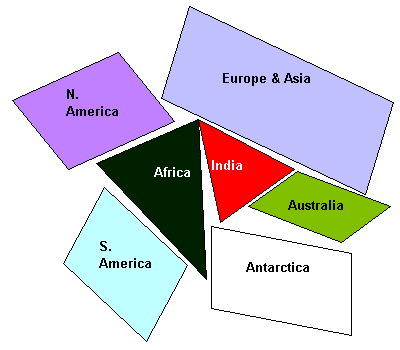
    As the following diagram shows, Earth was once a single land mass called Pangaea. Imagine a ball exploding and breaking into pieces. Now, imagine those pieces as our present continents separated by oceans. The fit between South America and Africa is very clear indeed, but the other continents need a lot more imagination because 'continental drift' - constant movement of the sea-bed plates - has pushed some land masses far away from their original placement.

    India, for instance, is now a sub-continent having jammed into Asia; and what is now Australia and the Antarctica once comprised the great southern continent of Gondwanaland. In about 40 million years it is expected that Australia will similarly collide with South-East Asia.


    Labels: , , , , , , , , , ,

    Copyright 2006-2014 Migration History

    why did our ancestors migrate?

    Our earliest ancestors were nomadic hunter and gatherer types, always on the move, and not much different in appearance and habits from the apes. The reasons that finally forced so many of them to leave their equatorial homelands to find new places to inhabit are very similar to the reasons that modern migrants give. Either there is a cataclysmic event - such as a flood or earthquake - or a social event such as a population explosion.

    When populations reach a certain size over and above that which can be called comfortable and manageable, tribes tend to develop and with this phenomenon comes tribal warfare over all manner of issues - particularly food, space, mating and leadership.

    In the vast and dense rainforest region of Equatorial Africa, it took millions of years before our ancestors had developed sufficiently to reach a population size that could be called crowded, but when that point was reached migration became a matter of survival.

    Bearing in mind that our early ancestors were competing for food and space not only with each other but also with all manner of predatory or dangerous animals, the rainforest may have been a fecund area but it was also an extremely dangerous place to live.

    Faced with depleting opportunities to find food, a mate, a safe place to sleep or merely congenial neighbors, most of our ancestors were literally forced out of their equatorial homeland. Others, more likely to be the migrants who traveled furthest - and from whom we owe our more direct evolutionary ancestry - had an adventurous or entrepreneurial streak and probably left long before they were pushed.

    As animal species also evolved in all parts of the world, the overcrowded conditions in the rainforest caused the animals to explore new pastures, too; and in this scenario it's possible that our ancestors followed them as a source of food. With the hunters in pursuit, the animals moved further and further away from the rainforest until there was no going back for either of them - even if seasonal migration was their pattern.

    Labels: , , , , , , , , , ,

    Copyright 2006-2014 Migration History

    early migration routes

    Unlike more modern migrants, whose journey is defined by a target destination and a well-trodden route, the first migrants had no idea where they were going or the hazards they would face.

    It is important to remember that many millions of years ago, when the initial emigration was taking place, the geography of the Earth was very different to what it is now. There was one continental land mass, called Pangaea which facilitated migration west towards what is now South America and east towards what is now India and Australia.

    After the cataclysmic events that split Pangaea into our present continents, the most amazing isolation of all species took place. North and South America - and Australia - remained unknown continents, with unknown people, and unknown civilizations until relatively recent times.

    Africa remained the centre of the human universe, but now the migratory routes had to follow coastlines and mountain ranges. The region between the western Highlands of Cameroon and the eastern mountain ranges appears to provide a natural inland corridor north, as well as a coastal escape route south and west.

    Without the means to ford wide rivers or traverse high mountains, this corridor provided the means by which countless people and animals over countless years migrated out of Equatorial Africa.

    Those who trekked north either followed the banks of the River Nile as it flowed down to the Mediterranean Sea through lands we know now as Sudan and Egypt; or they followed the East African mountain ranges through lands we know now as Uganda, Ethiopia, Sudan and Egypt. Taking the latter route, some may have found a pass through the mountain ranges to end up on the shores of the Indian Ocean in the land we know now as Kenya, and trekked from there along the eastern coastline and the Red Sea up to the eastern shores of the Mediterranean Sea.

    Those who trekked west followed the coastline west, and then north, to lands we know now as Nigeria, Ghana, Ivory Coast, Guinea, Senegal and Mauritania; and when they reached Morocco, on the western shores of the Mediterranean Sea, they were then able to cross into Europe via Spain - just as they do now.

    Fossil evidence, however, shows that the very earliest of the migrants trekked south - following the coastline to lands we know now as Angola, Namibia and South Africa. From the southernmost tip of Africa, it was then possible for them to follow the coastline north up the eastern coast of Africa through lands we know now as Swaziland, Mozambique, Somalia, Ethiopia, Sudan and Egypt until they, too, reached the eastern shores of the Mediterranean Sea.

    Labels: , , , , , , , , , , , , , ,

    Copyright 2006-2014 Migration History